
Surprising claim to start: doing an exchange inside a mobile or desktop wallet can be more private than using a popular centralized exchange — but only if you understand three invisible choices it forces you to make. That counterintuitive fact is true because built-in swaps can remove a visible middleman from on‑chain records and keep private keys on your device; however, they also replace that middleman with a different set of trust, routing, and metadata trade‑offs. For a privacy‑minded user in the U.S., the question is not whether in‑wallet swapping is private in absolute terms, but which privacy properties you gain or surrender when you pick one wallet and one route over another.
In this piece I compare two practical approaches: in‑wallet decentralized routing (the kind used by many modern privacy wallets for cross‑chain swaps) versus using external exchanges or custodial services. I focus on three currencies where privacy differentials matter most for U.S. users — Monero (XMR), Bitcoin (BTC), and Zcash (ZEC) — and I walk through mechanism, threats, limits, and an operational decision framework you can reuse.
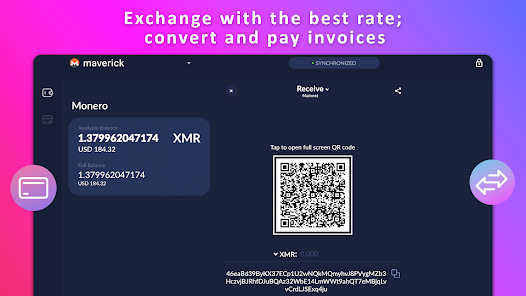
How in‑wallet exchange works (mechanics at a glance)
When an app offers a built‑in swap, it is performing three core tasks: (1) discovering one or more counterparties or market makers who will take the other side of your trade; (2) routing or composing the transactions so your funds leave one chain and arrive on another; and (3) executing settlement while minimizing custody exposure. Implementations vary, but the privacy and security implications flow directly from those steps.
Decentralized routing mechanisms — such as NEAR Intents used by some wallets — search multiple market makers and construct routes without a single centralized order book. That reduces single‑point censorship and concentration risk. In practice, NEAR Intents automates route discovery so the wallet can split or stitch together offers to get a competitive rate. This delivers a key advantage for privacy: the route is built from multiple liquidity sources, so there’s no single counterparty that necessarily sees your full trade history.
But “decentralized” here does not mean “invisible.” Each market maker and each hop in a multi‑leg swap still sees metadata: counterparty IPs, amounts on its side of the swap, timing, and the addresses or transaction outputs it signs. The wallet can mitigate metadata leakage by offering Tor/I2P and by letting you select custom nodes, and by keeping private keys non‑custodial within device hardware (Secure Enclave or TPM), but routing still creates an attack surface that differs from simply broadcasting a native on‑chain transaction.
Side‑by‑side: in‑wallet swaps vs external exchanges — security and privacy trade-offs
Below I break the trade‑offs into four domains users care about: custody, network metadata, on‑chain traceability, and operational risk.
Custody. External custodial exchanges hold your keys and can tie identity to funds via KYC; in‑wallet swaps are non‑custodial by design if the wallet never exports keys. A wallet that is open‑source and uses device‑level encryption (Secure Enclave/TPM) combined with hardware integration (Ledger or air‑gapped Cupcake) gives the strongest custody posture. That architecture means you control private keys locally, which materially reduces the risk of large custodial thefts — a common failure mode in U.S. incidents.
Network metadata. Centralized services know your IP and account data. Wallets can be better if they include Tor‑only mode, I2P support, and allow custom node connections. However, decentralized routes still expose your transaction to the network peers in each hop. Use of Tor and connecting to your own nodes are decisive mitigations: they reduce the ability of an observer to link the network origin of transactions to an individual device. In practice, expect improved anonymity if you combine Tor/I2P with subaddressing and strict no‑telemetry policies.
On‑chain traceability. Monero is fundamentally different from Bitcoin: XMR is privacy‑focused by design, using ring signatures and stealth addresses. A wallet that stores the private view key locally and supports subaddresses preserves those guarantees; background sync and subaddress use help avoid address reuse. Bitcoin, however, is transparent by default and suffers from UTXO linkability. Wallets can improve BTC privacy with tools like PayJoin v2, Silent Payments, coin control, and transaction batching — but these are mitigations, not native privacy. Litecoin with MWEB adds an optional privacy layer; activating it changes on‑chain visibility but also creates interoperability choices.
Operational risk and limits. Some currencies and migration paths carry special constraints. For example, Zcash handling requires mandatory shielding to avoid leaking transparent addresses: a wallet that enforces outgoing transactions from shielded (z‑) addresses reduces a common user mistake. But migration from other wallet types (e.g., Zashi) can be imperfect: incompatible seed handling for ZEC means manual transfers are necessary. These operational frictions are where users trip up — and mistakes at this stage are often the weakest link for privacy.
Monero vs Bitcoin vs Zcash: specific considerations for U.S. users
Monero (XMR): If your priority is low on‑chain traceability, Monero is the strong default. A wallet that keeps the private view key on‑device and supports subaddresses preserves Monero’s privacy model. Background sync that doesn’t leak transaction details to third parties matters for convenience without sacrificing anonymity. The main remaining attack vectors are network‑level deanonymization (mitigated by Tor/I2P) and operational mistakes (address reuse, restoring seeds to compromised devices).
Bitcoin (BTC): For BTC, privacy is incremental. In‑wallet features like PayJoin v2 and UTXO coin control reduce linkage, but they do not create Monero‑level privacy. Decentralized swaps can help by avoiding centralized KYC counterparties; yet the hops themselves can leak timing and amount correlations. U.S. users should assume on‑chain BTC activity can be correlated with other public records unless they aggressively use network obfuscation and privacy techniques.
Zcash (ZEC): ZEC has shielded and transparent modes. Ensuring all outgoing transactions originate from shielded addresses — mandatory shielding — is an effective protection against accidental leaks. But be aware of migration quirks: seed incompatibilities with other wallets (such as Zashi) mean automated migration may fail; manual transfers to a freshly created shielded wallet are the safe path. U.S. regulatory attention to shielded pools can change operational constraints — a risk to monitor.
Decision framework: choosing the right approach for your goal
Use this short heuristic when deciding whether to use an in‑wallet swap or an external exchange:
1) If custody is the biggest worry (hacks, seizure), prioritize non‑custodial, hardware‑backed wallets and keep keys local. 2) If network metadata is the primary threat (do you fear ISP or state‑level correlation?), insist on Tor/I2P and custom node support before swapping. 3) If on‑chain anonymity is paramount, choose a native private coin (Monero) and avoid cross‑chain rounds that reveal amount/timing correlations unless the swap uses multi‑leg, privacy‑aware routing and you deliberately split amounts. 4) If operational simplicity and liquidity are your constraints (you need fiat rails or large liquidity), an external exchange may be unavoidable — but treat that as a custody trade‑off and minimize retained balances there.
One practical rule of thumb: use in‑wallet swaps for moderate, privacy‑aware trades where you keep the private keys and can route via Tor; use reputable exchanges only when liquidity or fiat conversion is necessary and then limit exposure with small balances and withdrawal discipline.
Where the design choices matter most — and common failure modes
Three concrete failure modes recur in audits and incident reports: mistaken seed restoration, accidental transparent broadcasts, and network fingerprinting during swaps. The first two are user/UX failures that good wallet design can reduce: clear migration guidance for ZEC and mandatory shielding are examples of protective defaults. The third — network fingerprinting — is technical and often invisible to users: if the wallet fails to route through Tor consistently, your swap counterparties and network observers may link transactions to your IP fingerprint. Check a wallet’s Tor/I2P implementation, and prefer wallets with a strict no‑telemetry policy.
Another important boundary: decentralized routing systems like NEAR Intents lower reliance on centralized matchers, but they do not eliminate counterparties who still learn partial trade information. Treat route discovery as privacy‑improving, not privacy‑perfecting. If you need guaranteed non‑linkage, native privacy coins or layered protocols specifically designed for atomic, non‑revelatory swaps are the better route — but they are also less liquid and more complex.
What to watch next (signals, not forecasts)
Several developments will materially affect the value proposition of in‑wallet swaps: wider adoption of PayJoin v2 and other privacy‑enhancing Bitcoin standards; regulatory scrutiny of shielded pools that could push UX or protocol changes for ZEC; and improvements in decentralized routing protocols that reduce the number of counterparties needed per swap. For U.S. users, keep an eye on regulatory guidance around shielded transactions and on whether wallets make Tor‑only defaults easier to enable. Those changes will shift the balance between convenience and provable privacy.
If you want a practical next step: test a wallet in a low‑value environment. Create a new wallet, enable Tor-only mode, perform a small in‑wallet swap using decentralized routing, and examine logs (or absence of logs) to see where metadata could have leaked. That empirical approach is the fastest way to build trust in a tool that will handle your keys and privacy.
For users who want a wallet with the specific privacy and multi‑currency capabilities discussed here — including enforced ZEC shielding, NEAR Intents routing, Monero subaddress protections, Tor/I2P support, device encryption, and hardware integration — consider evaluating options that publish their code and clearly document migration limitations and privacy-preserving defaults such as mandatory shielding and zero telemetry. One such multi‑platform, open‑source option that collates these features is available at cake wallet.
FAQ
Is an in‑wallet swap ever as private as sending Monero directly?
No. Native Monero transactions are inherently private at the protocol level. In‑wallet swaps involving other chains introduce cross‑chain metadata and counterparties; they can be much more private than an exchange in some configurations, but they cannot increase the base privacy of a transparent blockchain to Monero levels. The practical takeaway: use direct Monero transactions where end‑to‑end privacy is required; use in‑wallet swaps when you need multi‑currency convenience and accept some additional metadata risk.
Does mandatory ZEC shielding make migration harder?
Mandatory shielding prevents accidental leaks from transparent addresses but does add migration friction. If you are moving ZEC from wallets that use different seed or change‑address semantics (for example, certain Zashi wallets), automated restoration may not work. The safest path is manual transfer into a newly created shielded wallet to avoid losing funds or exposing transparent outputs.
Can Tor and I2P eliminate all network‑level deanonymization?
Tor and I2P substantially reduce exposure to ISP‑level and simple observer correlation, but they are not a panacea. Advanced global adversaries that control multiple nodes, use timing analysis, or correlate across services can still infer links. Combine network obfuscation with good on‑chain hygiene (address reuse avoidance, coin control) for practical resilience.
Should I trust a wallet because it is open‑source?
Open‑source code increases transparency and allows community review, but it is not a substitute for operational security or careful configuration. Review whether the project publishes build reproducibility, documentation of its privacy design choices (for example, mandatory shielding and zero‑telemetry), and integration paths for hardware security modules. Where possible, test behavior on small amounts before moving larger balances.